

5 Small Plumbing Leaks That Can Lead to Big Repair Bills
/
There’s something funny about plumbing leaks.
If a pipe suddenly bursts and water is pouring across the floor, nobody wonders whether they should deal with it. You shut off the water, grab every towel you own, and start making phone calls.
It’s the little leaks that are much easier to ignore.
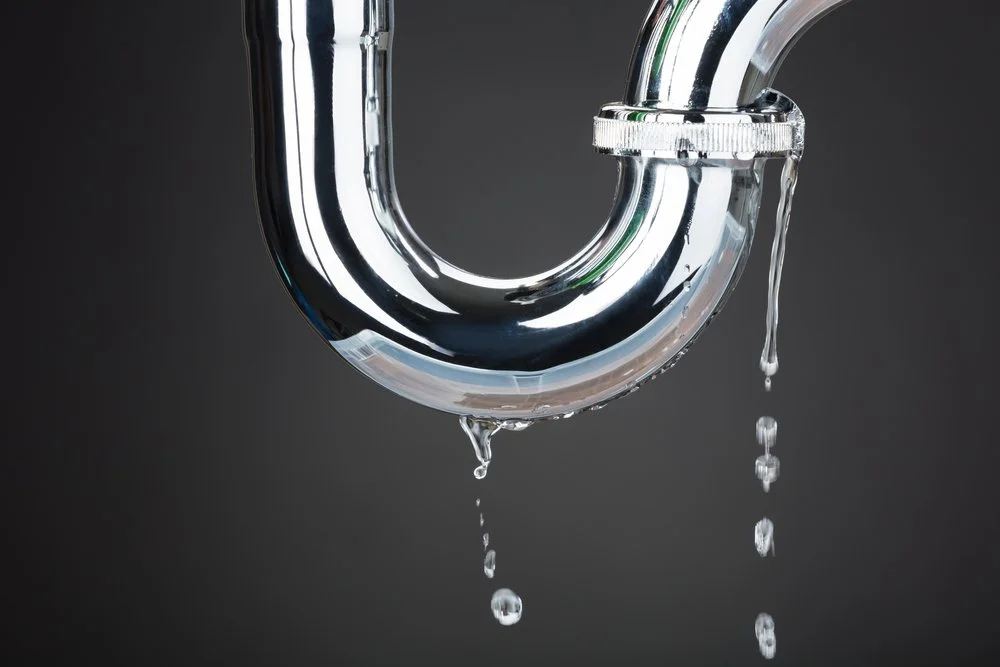
A tiny drip under the kitchen sink. A toilet that seems to run every once in a while. A little bit of water around the base of a faucet. A faint stain on the ceiling that you’re pretty sure wasn’t there before.
And because nothing dramatic is happening, it’s very easy to think, I’ll keep an eye on it.
We understand that.
Nobody wants to call a plumber every time they notice something slightly unusual in their home. There’s also that little worry in the back of your mind: What if I call someone and this turns into an expensive repair?
Unfortunately, water has a habit of making that decision for us.
A small plumbing leak can sometimes go unnoticed for weeks or months, quietly damaging cabinets, drywall, flooring or even the structure underneath. By the time the damage becomes obvious, repairing the leak itself may be the least expensive part of the job.
So, grab a coffee and let’s talk about five small plumbing leaks that are worth paying attention to—and what you can look for before they become much bigger problems.
1. The Slow Leak Under Your Kitchen or Bathroom Sink
Let’s start with one of the most common ones.
You open the cabinet under your kitchen sink to grab the garbage bags and notice the bottom of the cabinet feels a little damp.
Maybe there’s a small water mark.
Or perhaps you notice a musty smell but can’t immediately figure out where it’s coming from.
Leaks under sinks can come from several places, including supply lines, shut-off valves, drain connections, the faucet itself or the sink strainer.
The tricky part is that some of these leaks only happen when you're using the sink.
A drain connection, for example, may remain perfectly dry until you fill the sink or run a significant amount of water through it. A faucet may leak underneath only while the water is running.
That means you can look under the sink several times and see absolutely nothing.
How do I know if my sink is leaking underneath?
Take everything out of the cabinet and dry the area completely. Then run the faucet while watching the supply lines and connections.
Next, fill the sink with some water and drain it while watching the drainpipes underneath.
You can also place a dry piece of paper towel beneath the plumbing connections. Even a very small amount of water will usually show up quickly on the paper towel.
Is a small leak under the sink really a big deal?
It can become one.
Cabinet materials don't particularly like water. Repeated exposure can cause the cabinet bottom to swell, warp or deteriorate. Moisture can also work its way into the wall or flooring.
And because the inside of a sink cabinet is dark and enclosed, dampness may remain there for quite a while.
The good news? If you catch the leak early, you may be dealing with a relatively straightforward plumbing repair rather than replacing part of your cabinet or repairing damaged flooring.
That’s why we’d much rather have someone call us and discover that the problem is minor than wait until the cabinet floor feels like a wet sponge.
2. The Toilet That Leaks Around the Base
Here’s another one people often put off.
You notice a little water around the bottom of the toilet.
You wipe it up.
A few days later, there it is again.
It may not even be enough water to form a puddle, so it’s tempting to assume someone splashed water getting out of the shower or that it’s condensation.
Sometimes it is.
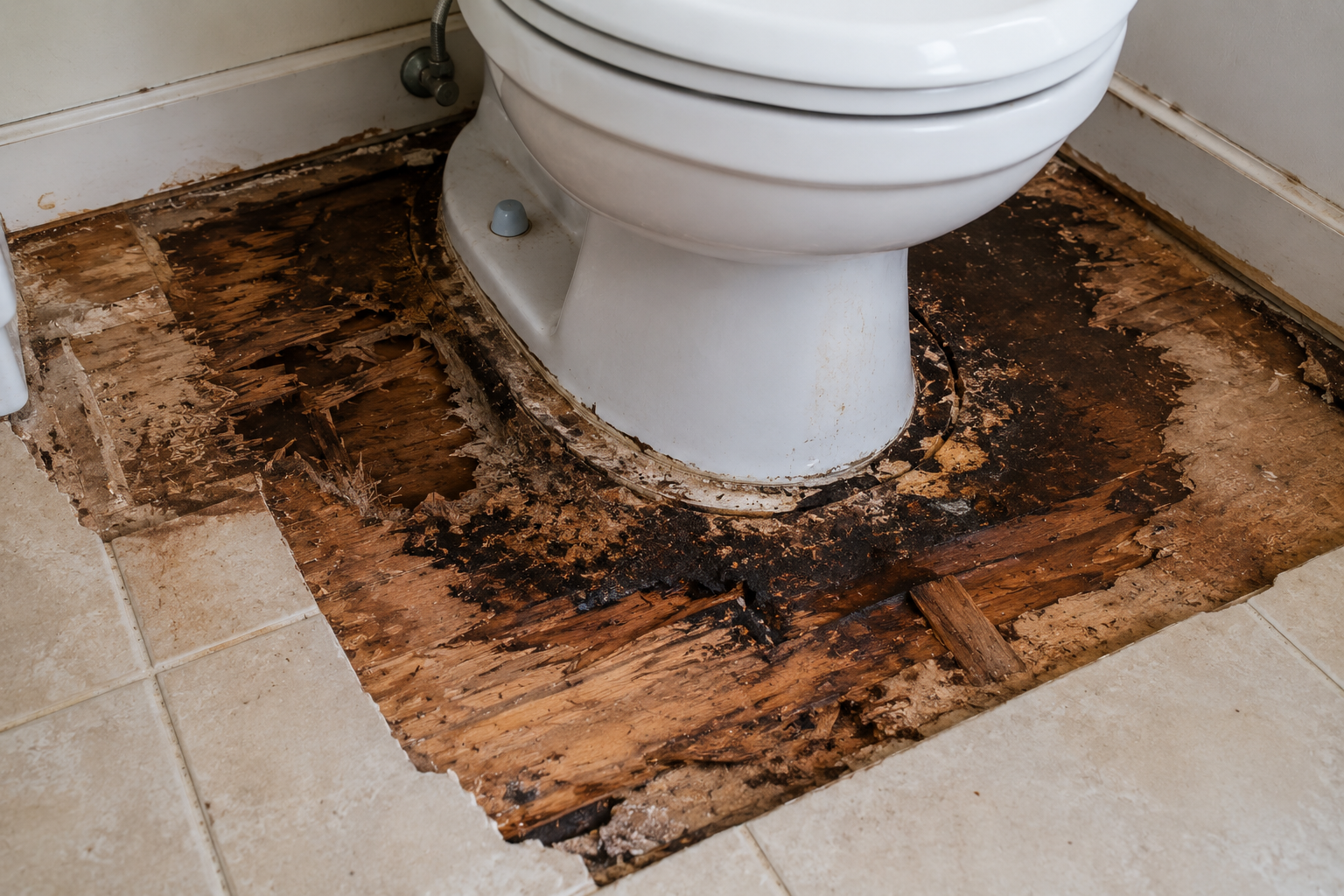
But recurring moisture around the base of a toilet deserves a closer look.
One possible cause is a failed seal between the toilet and the drain. The toilet may also be loose or there may be another leak involving the tank, supply line or connection that is travelling downward and appearing at the floor.
What happens if a toilet leaks at the base?
This is where a relatively small plumbing problem can turn into a much more expensive repair.
If water is repeatedly getting underneath the toilet, it can damage the flooring and the subfloor below it.
And because that damage is hidden, you may not realize what is happening until the floor around the toilet starts feeling soft or the toilet begins to move.
If the bathroom is on the second floor, you might even discover the problem because a stain appears on the ceiling below.
At that point, you aren't necessarily dealing with just a toilet repair anymore. There may also be flooring, subfloor, ceiling or drywall repairs to consider.
Should there ever be water around the base of my toilet?
As a general rule, recurring water around a toilet shouldn't be ignored.
Dry the area thoroughly and see whether the moisture returns. Look at the toilet supply line and the connection between the tank and bowl as well.
And if you can't identify where the water is coming from, that's a good time to have it investigated.
You don't need to panic. You just don't want to give water weeks or months to do damage where you can't see it.
3. The Tiny Drip From a Faucet or Shut-Off Valve
Drip.
Drip.
Drip.
We tend to think of a dripping faucet as annoying rather than damaging.
And if the water is simply dripping directly into the sink, the biggest immediate concern may be wasted water.
But not every faucet leak conveniently drips into the sink.
Sometimes water leaks around the base of the faucet and travels underneath the fixture. Sometimes a shut-off valve develops a very slow leak. Sometimes a supply connection is just damp enough that you don't notice it unless you actually touch it.
These tiny leaks are particularly easy to miss.
How can I check my faucet and shut-off valves for leaks?
Every so often, open the cabinet and actually touch the plumbing connections.
They should be dry.
Run your fingers around the shut-off valves, supply lines and underside of the faucet.
Again, a piece of dry paper towel is your friend here. Run it around the connections and see whether it picks up any moisture.
You can do the same thing around the base of the faucet on top of the counter.
Can a dripping faucet cause damage?
If the water is contained entirely within the sink, it may not cause damage to your home, although it can certainly waste water and usually indicates that something needs repair.
If water is escaping around the faucet or underneath the sink, however, that's a different story.
Even a very small amount of water repeatedly reaching a countertop, vanity, cabinet or wall can eventually cause swelling, staining and deterioration.
Think of it this way: one drop isn't the problem.
Thousands and thousands of drops over several months can be.
4. The Shower or Tub Leak You Can't See
This is probably one of the leaks that worries homeowners the most because so much of the plumbing is hidden.
You can't exactly look behind your shower wall every Saturday morning to make sure everything is dry.
So how do you know if something is leaking?
Sometimes the first clue isn't in the bathroom at all.
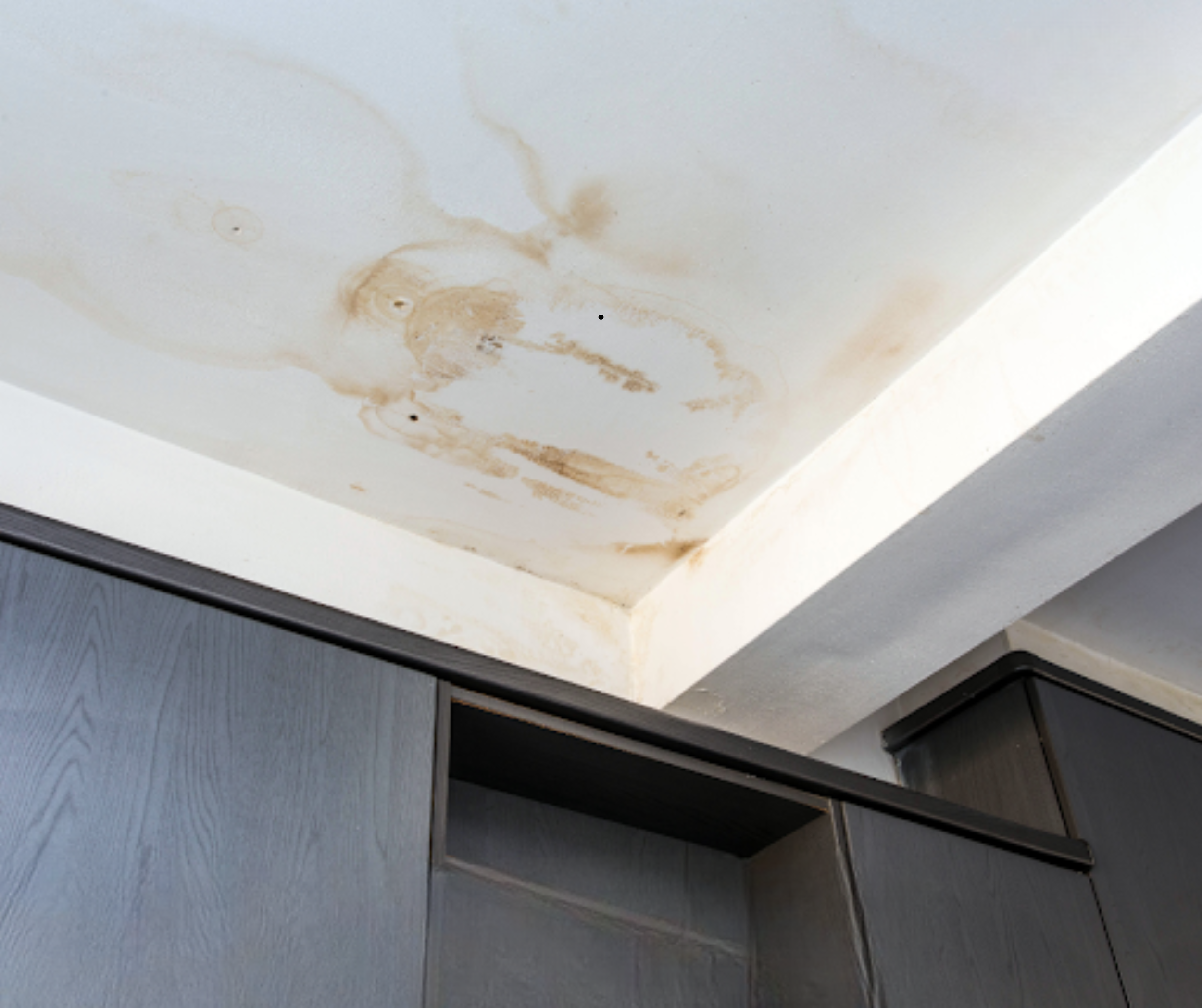
It may be a water stain on the ceiling below.
You might notice bubbling or peeling paint.
A baseboard near the tub might start swelling.
The drywall on the other side of the bathroom wall may feel damp.
Or you may notice a musty smell that doesn't seem to go away.
Does a ceiling stain mean I have a plumbing leak?
Not necessarily—but it means you should find out where the moisture came from.
If there's a bathroom above the stain, plumbing is certainly one possibility.
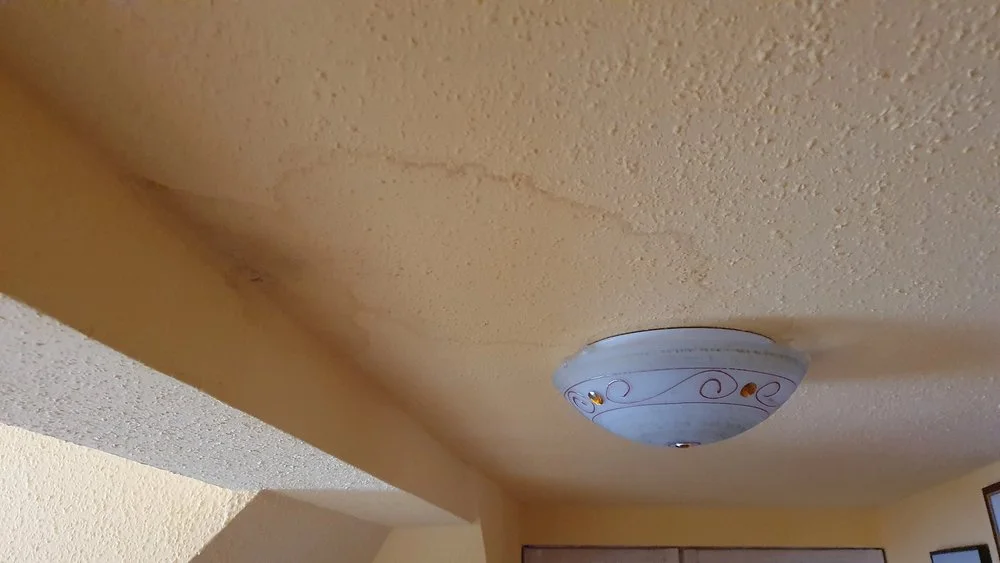
The source could be a drain, supply line, shower valve, tub connection, toilet or even water escaping around the shower or tub because of a failed seal.
One important thing to remember is that the location of the stain doesn't always tell you exactly where the leak is.
Water can travel along pipes, framing and other materials before it finally becomes visible.
A Real-Life Example of How Misleading a Leak Can Be
We actually had this happen with one of our own clients.
We had recently upgraded her shower, which included taking it apart and retiling it. Sometime afterward, she noticed that dreaded water stain on the ceiling directly below the bathroom—and then water actually started coming through the ceiling.
Naturally, she immediately thought the newly renovated shower was leaking.
And honestly, we could understand why. If you've recently had work done on a shower and then water appears on the ceiling directly below it, wouldn't that be your first thought too?
Paul went to the house and started testing. He ran water, checked the shower and performed the usual tests he would use to try to recreate a leak. He walked the homeowner through what he was doing so she could see the testing herself.
Nothing.
Everything was bone dry.
He went beyond the normal testing as well, trying to recreate the circumstances that could possibly have caused water to appear downstairs. Still nothing. There was simply no evidence that the shower was leaking.
At that point, there wasn't much more to do other than ask the homeowners to keep an eye on it and see whether the water appeared again.
And eventually, it did—but this time they happened to be in exactly the right place at exactly the right moment.
Our client was downstairs in the kitchen while her husband was upstairs using the bathroom. He flushed the toilet and, almost immediately, water started coming through the kitchen ceiling.
Mystery solved.
The leak had nothing to do with the shower at all. It was coming from the toilet.
And here's the slightly funny ending to the story: her husband had installed the toilet himself. So after initially being convinced that the leak was the result of our workmanship, she was very apologetic when they discovered where the water was actually coming from.
We all had a little laugh about that one.
But it's also a perfect example of why diagnosing a water leak isn't always as straightforward as looking directly above the stain.
Water can travel. Two plumbing fixtures can be relatively close together. And sometimes the thing that seems like the most obvious explanation isn't the explanation at all.
That's also why we don't recommend immediately opening walls, tearing apart a shower or making repairs based solely on where the water appears. Whenever possible, the first step should be to investigate, test and try to identify the actual source of the leak.
Sometimes your ceiling stain is telling you there's a problem upstairs.
It just isn't necessarily telling you which problem.
Not Sure Where That Water Is Coming From?
If you’ve noticed a little moisture, a suspicious stain or a drip that keeps coming back, you don’t have to assume the worst—but it is worth finding out where it’s coming from. Multi-Trade Building Services provides licensed plumbing services throughout Durham Region, and we’d be happy to help you investigate the problem before a small leak has the chance to become a bigger one.
Can a shower leak only when it's being used?
Absolutely.
That's one reason these problems can be difficult to diagnose.
A drain may leak only while the shower is running. Water may escape around a shower enclosure only when someone is actually showering. A plumbing connection may leak under certain conditions but remain dry the rest of the day.
If you're seeing signs of moisture, don't assume the problem has disappeared simply because everything looks dry a few hours later.
Something caused that water to be there.
The goal is to figure out what before repairing the cosmetic damage.
Painting over a ceiling stain without finding the source of the moisture is a bit like putting a Band-Aid over your car's check-engine light. It may look better, but you haven't solved the problem.
5. The Slow Leak From a Dishwasher, Refrigerator or Washing Machine Connection
This last category is easy to overlook because we don't always think of appliances when we think about plumbing leaks.
But several appliances in your home have water supply or drain connections.
Your dishwasher does.
Your washing machine does.
And if your refrigerator has a water dispenser or ice maker, it probably does too.
A connection behind an appliance can develop a small leak without you knowing because, well, how often do you pull your refrigerator out to inspect the floor behind it?
Probably not very often.
Neither do most people.
What are the signs of an appliance water leak?
Watch for flooring that begins to lift, buckle or discolour near the appliance.
You might notice a musty smell.
There may be unexplained moisture beside or underneath the appliance.
With a dishwasher, you might see water appearing along the bottom of the cabinets or near the toe kick.
With a washing machine, inspect the hoses and connections periodically rather than waiting for something to fail.
Can a refrigerator water line cause major damage?
Unfortunately, yes.
Because the line is connected to your home's water supply, even a relatively small ongoing leak can release a surprising amount of water over time.
And because refrigerators are rarely moved, that water can remain hidden behind or underneath the appliance.
By the time the flooring shows obvious signs of damage, the leak may have been happening for quite some time.
How Do You Know If You Have a Hidden Plumbing Leak?
Sometimes there isn't an obvious puddle pointing directly at the problem.
Instead, your house gives you smaller clues.
You may notice:
A water bill that is unexpectedly higher than normal
A musty or damp smell
Bubbling or peeling paint
Stains on walls or ceilings
Swollen baseboards or cabinetry
Flooring that is lifting, buckling or changing colour
The sound of water when nothing is running
Damp areas that keep returning after you dry them
A toilet that moves or rocks
Water meter activity when no water is being used
None of these automatically means you have a catastrophic plumbing problem.
And that's important.
If you've just spotted something on this list and your stomach has dropped a little, don't immediately assume you're looking at thousands of dollars in repairs.
You may have caught something early.
The important part is not ignoring a sign simply because you're afraid of what you might find.
When Is a Plumbing Leak an Emergency?
If water is actively flowing or spraying and you can't contain it, that's an emergency.
If it's safe to do so, shut off the water supply to the affected fixture—or your home's main water supply if necessary—and call for help.
A slow drip or small amount of moisture may not require an emergency call, but it still deserves attention.
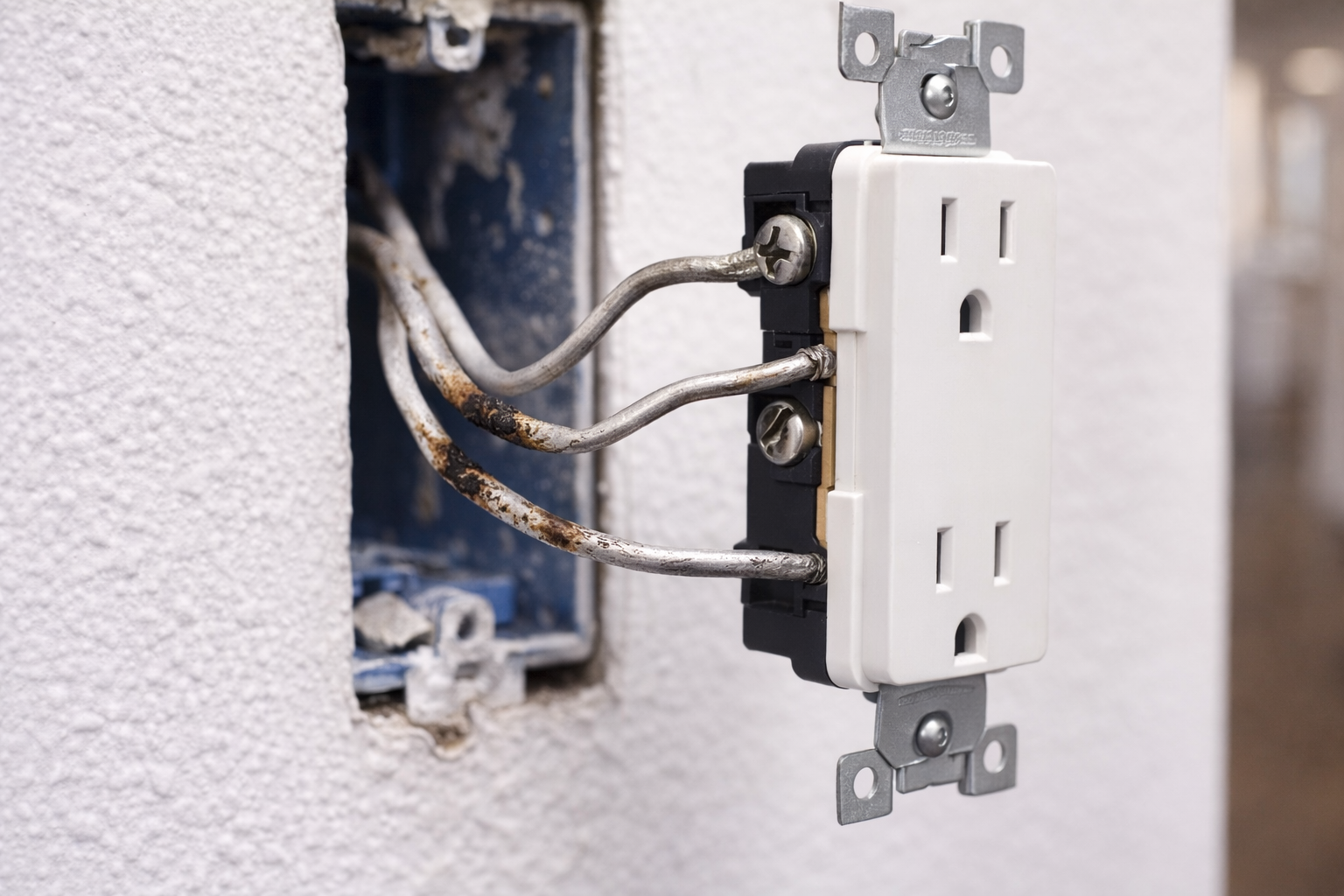
And if water is near electrical wiring, receptacles, fixtures or your electrical panel, don't take chances. Water and electricity are a combination that needs to be treated seriously.
“But What If I Call a Plumber and It Turns Into a Huge Repair?”
We understand this fear more than you might think.
Sometimes homeowners apologize when they call us.
They'll say, “This is probably nothing…”
Or they'll tell us they've been putting off the call because they were afraid of what we might find.
But finding a problem doesn't create the problem.
It was already there.
Finding it simply gives you the opportunity to decide what to do about it.
And very often, catching a plumbing leak early gives you more options and can keep the repair much smaller.
A leaking connection may need to be tightened or replaced.
A toilet may need to be reset.
A faucet may need repair.
Those are very different conversations from replacing water-damaged cabinets, flooring, drywall and subfloor because a small leak was allowed to continue unnoticed.
A Five-Minute Plumbing Check You Can Do Today
Here's something simple you can do after you finish your coffee.
Walk around your home and spend five minutes checking the places where water is used.
Open the cabinets underneath your kitchen and bathroom sinks.
Feel around the plumbing connections.
Look around the bases of your toilets.
Look at the ceilings below bathrooms.
Take a quick look around your dishwasher, refrigerator and washing machine.
You're not trying to become a plumber.
You're simply getting familiar with what “normal” looks like in your own home.
That way, when something changes, you're more likely to notice it.
Small Leak Doesn't Always Mean Small Damage
If there's one thing we'd like you to take away from this conversation, it's this:
Don't panic over a small plumbing leak—but don't ignore it either.
Water damage isn't usually about one dramatic drop of water. It's about moisture being allowed to sit somewhere it doesn't belong, over and over again.
If you notice a drip, stain, damp cabinet, soft floor or mysterious bit of moisture, investigate it.
Maybe it's nothing serious.
Hopefully it isn't.
But we'd always rather tell a homeowner, “Good news—you caught this early,” than have to explain that a small leak has been quietly damaging their home for months.
And if you're not sure where the water is coming from, that's exactly what a professional can help you figure out.
At Multi-Trade Building Services, we provide licensed plumbing services throughout Durham Region and can investigate those little leaks before they have the opportunity to become much bigger ones.
Because when it comes to water, a little attention today can save you a much bigger repair tomorrow.
Have a Plumbing Leak? Let’s Find It Before It Gets Worse.
If you’ve spotted water where it shouldn’t be, don’t wait for a small plumbing problem to turn into damaged flooring, cabinets, drywall or ceilings.
Multi-Trade Building Services provides licensed plumbing services throughout Durham Region. Whether you have a dripping connection, a leaking toilet, water under a sink or a mysterious stain and have no idea where it’s coming from, we can investigate the problem, determine the likely source and talk you through what needs to happen next.
Contact Multi-Trade Building Services today to schedule a plumbing service call.

Looking after your home doesn’t have to mean tackling everything at once. A little preventative maintenance—and knowing which warning signs to pay attention to—can go a long way toward preventing bigger, more expensive problems down the road.








That tiny drip under the sink or mysterious stain on the ceiling might not seem urgent, but small plumbing leaks can quietly cause significant damage over time. Here are five leaks worth watching for, the warning signs you shouldn’t ignore, and how catching them early could save you from a much bigger repair bill.